

If you have combination skin, you already know the problem with most cleansing routines: the same product and the same pressure that clear up your T-zone can leave your cheeks feeling tight and stripped. I spent 14 years behind a department store beauty counter watching women buy one cleanser for their oily forehead and another for their dry cheeks, then try to scrub the difference away with a washcloth. The COSLUS Facial Cleansing Brush is the tool I now reach for on weekday mornings, and the routine that follows is the one I actually use on my own combination skin.
This is not a complicated five-step ritual. It is the order of operations that keeps my oily T-zone under control without turning my dry winter cheeks into sandpaper. If you have combination skin and a cleansing brush that is gathering dust, this is the routine that finally made mine earn its place on the counter.
The brush that finally made my combination skin behave
The COSLUS Facial Cleansing Brush uses soft silicone bristles and three speed settings, so you can give your T-zone a deeper clean and your cheeks a gentler pass without switching tools. It is the one I keep on my own vanity.
Amazon Check Today's Price on Amazon →Step 1: Start with dry skin and a cleanser you already trust
The biggest mistake I see with cleansing brushes is using them like a power tool on wet, slippery skin. You end up pressing harder than you mean to, and the brush skids across your face instead of actually cleaning. I start with a dry face and a cleanser I already know agrees with me. For my combination skin, that is a gentle foaming gel cleanser, the kind that does not leave my cheeks feeling tight.
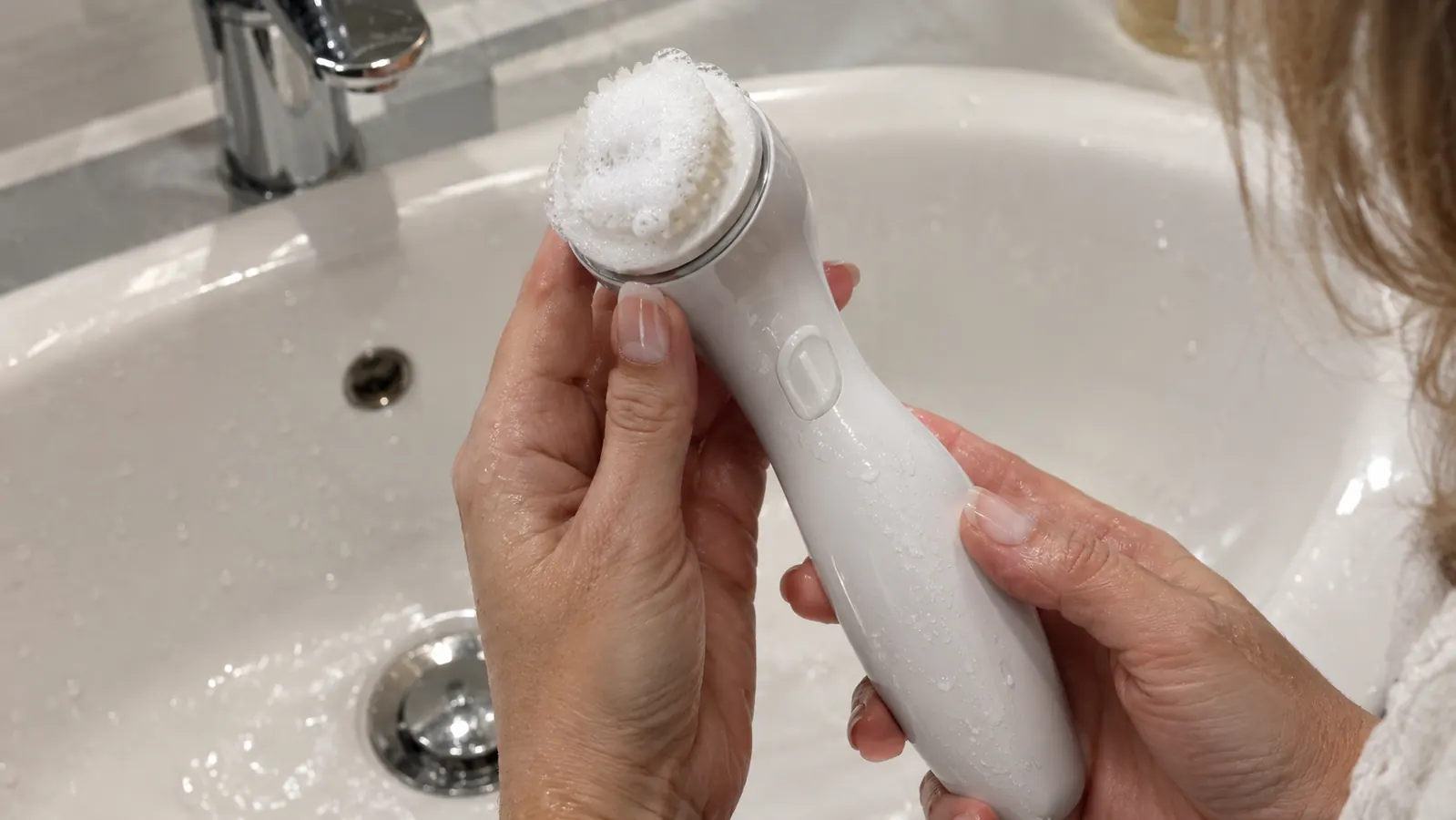
Wet the brush head, add a small amount of cleanser directly to the silicone bristles, and switch the COSLUS brush on at the lowest speed before it touches your face. The bristles are soft silicone, not nylon, so they do not scratch or drag the way older brush heads did. You want the brush to glide, not scrub.
If your cleanser does not foam much, add a few drops of water to the bristles before you turn the brush on. The COSLUS brush works with whatever cleanser you already use, which is one of the reasons I stopped reaching for my old spinning brush. No special cleanser required, no extra cost per month.
Before the COSLUS brush, I went through a phase with a spinning nylon brush, the kind with the rotating head and the battery pack. It worked on my forehead for about a week, and then my cheeks started flaking like I had used a chemical peel. I tried swapping to a gentler cleanser, then a cream cleanser, then a balm, and none of it fixed the problem, because the brush itself was too harsh for the dry half of my face. I gave up on cleansing brushes entirely for about a year and went back to washing with my hands. That worked, but my T-zone never felt quite clean, and the blackheads on my nose came back within a few weeks. The COSLUS brush was the first one I tried with silicone bristles, and the difference showed up in the first week: no flaking on my cheeks, and my forehead actually stayed matte until lunch.
Step 2: Work in small circles, and let the brush do the pressure
Here is the part that took me years to learn: the brush should move across your skin, and your hand should barely press at all. I hold the COSLUS brush like a pen, with my fingertips resting lightly on the back, and let the silicone bristles do the work. Small circles, about the size of a dime, moving from the center of my face outward.
On my T-zone, where I am oily and prone to clogged pores, I use the middle speed setting and spend about 20 seconds on my forehead and nose. On my cheeks, where I get dry in the winter, I drop back to the lowest speed and keep my touch even lighter. The COSLUS brush has three speeds, and that difference between zones is the whole trick for combination skin.
Do not linger in one spot. Twenty seconds per zone is plenty. If you have ever seen a dermatologist recommend a cleansing brush, the advice is always the same: let the brush move, keep the pressure light, and never hold still on one patch of skin. The COSLUS brush makes that easy because the bristles are soft enough that you can feel when you are pressing too hard.
The morning I realized the routine was actually working was a Tuesday in late February, the kind of gray Ohio day when my skin usually looks dull by noon. I had been using the brush for about three weeks by then, and I did something I almost never do: I forgot to check my nose in the magnifying mirror before heading out. That night, Kayla asked if I had gotten a facial, and I had not. My pores on my nose and chin were visibly smaller, not just cleaner, and my cheeks had none of the tight red patches I used to get every winter. I timed myself that week to see whether the routine would fit my weekday mornings, and the whole thing, brush, rinse, moisturizer, took four and a half minutes from the moment I turned on the tap. That is the number that made me keep the brush on the counter instead of in the drawer.
Step 3: Rinse with lukewarm water, not hot
Hot water feels like it is cleaning deeper, but it strips the moisture barrier and leaves combination skin red and tight. I rinse my face with lukewarm water, then rinse the brush head under the same temperature. The COSLUS brush is fully waterproof, so I do not worry about getting the handle wet while I rinse it.
I also use this moment to check the bristles. Silicone bristles do not absorb cleanser the way nylon bristles do, so a quick rinse is usually enough. If I used a thicker cream cleanser, I rub the bristles gently with my thumb under running water for a few seconds. That keeps the brush from becoming a place where old product builds up.
One thing I tell everyone who buys a cleansing brush: rinse it after every single use, even if you are in a hurry. It takes ten seconds, and it is the difference between a brush that lasts for years and one that starts to smell like old cleanser after a few months.
I learned the hot water lesson the hard way one morning last January, when I was in a hurry and cranked the tap as hot as it would go. My face looked fine when I patted it dry, but by the time I got to the office my cheeks were pink and my moisturizer had balled up instead of sinking in. My skin was dehydrated, which for combination skin means the dry parts get flaky and the oily parts overcompensate by producing more oil. It took about three days of lukewarm rinses and a heavier night cream to get my moisture barrier back to normal. Now I test the water on the inside of my wrist before I put my face under it. If it feels warm but not hot, it is right. The COSLUS brush handle is fully waterproof, so I rinse the whole thing under the tap, bristles up, and give the handle a quick wipe with the corner of my towel before it goes back in the cup.

Step 4: Pat your face dry, then moisturize while skin is still damp
This is the step most people skip, and it is the one that matters most for combination skin. After I rinse, I pat my face dry with a clean towel. I do not rub. Rubbing dry skin after cleansing is the fastest way to undo everything the brush just did.
Then I apply moisturizer while my skin is still slightly damp. On my oily T-zone, I use a light gel moisturizer. On my cheeks, I use a slightly richer cream. The COSLUS brush gets my skin clean enough that my moisturizers actually sink in instead of sitting on top of a layer of leftover product.
If you only have one moisturizer, use it everywhere and just use a little more on the dry areas. The point is to lock in the water from your rinse. Clean skin that is properly moisturized is the goal, and the brush is the part that makes the cleanser work better, not the part that dries you out.
I know it is tempting to skip the moisturizer when your T-zone is shiny by ten in the morning, but that is exactly when combination skin needs it most. A few months ago, I skipped the moisturizer on my forehead for a week to see if it would cut down on the oil. It did the opposite: my forehead got oilier by the afternoon, because my skin was producing extra sebum to make up for the moisture I was stripping away with the cleanser. The morning my daughter Kayla borrowed the brush and then asked why her foundation looked patchy, I realized she had skipped the damp-skin moisturizer step entirely. I walked her through it, pat dry, gel moisturizer on the T-zone, a little richer cream on the cheeks, and her makeup sat differently by the end of the week. On my own skin, the combination of the COSLUS brush and a damp-skin moisturizer cut my winter flaking down to almost nothing.
Step 5: Use it once a day, and give your skin a break on weekends
You do not need to use a cleansing brush twice a day. I use the COSLUS brush once in the morning, and at night I wash my face by hand with the same cleanser. That gives my skin a break and keeps me from over-exfoliating, which is the most common mistake I see with any cleansing tool.
On weekends, I often skip the brush entirely on Saturday and use it on Sunday morning. Combination skin does not need aggressive daily exfoliation. The COSLUS brush is gentle enough for daily use, but gentler is still better. If my cheeks feel at all tight or sensitive, I skip a day and just wash by hand.
The brush holds a charge for a long time, so I only plug it in every couple of weeks. That matters to me because my bathroom vanity has exactly two outlets, and I do not want another cord living on the counter. The COSLUS brush sits in a little cup by the sink and is ready when I need it.
What Else Helps
A cleansing brush is only one part of a routine that works. I keep a few other things on the shelf that make the COSLUS brush work better. A soft cotton towel for patting dry, a gentle foaming cleanser that does not leave my cheeks tight, and a light gel moisturizer for my T-zone. I also replace the brush head every three to four months, which the COSLUS brush makes easy since the head detaches from the handle.
If you have combination skin, the other thing that helps is paying attention to the seasons. In the winter, I use the lowest speed everywhere and skip the brush an extra day each week. In the summer, when my T-zone is oilier, I use the middle speed on my forehead and nose. The COSLUS brush has enough settings that it works year-round, which is why it earns its spot on my counter instead of living in a drawer.
The whole trick for combination skin is not scrubbing harder. It is using the lowest speed on your dry cheeks and the middle speed on your oily T-zone, with the same brush.
Give your combination skin a routine that actually fits it
The COSLUS Facial Cleansing Brush is soft, waterproof, and has three speeds so one tool can handle both sides of your face. It is the brush I have used every morning for months, and the one I would buy again.
Amazon Check Today's Price on Amazon →